

Sudan is currently grappling with a “compounded crisis” where the devastating effects of climate change intersect with one of the world’s most severe humanitarian disasters. As of 2026, Sudan remains among the top ten most climatically vulnerable nations globally, facing a “perfect storm” of environmental degradation and active conflict.
Environmental Impacts: The “Uninhabitable” Risk
The synergy between rising temperatures and shifting rainfall is pushing parts of Sudan toward becoming uninhabitable.
- Desertification and Land Decay: Over 60% of Sudan’s land is susceptible to desertification. The Sahara is moving southward at an estimated rate of 1.5 km per year, swallowing vital agricultural belts in Northern and Kordofan states.
- The Flood-Drought Paradox: Sudan now experiences a volatile cycle of extreme drought followed by record-breaking flash and riverine floods. In 2024 and 2025, over 600,000 people were affected by floods that destroyed tens of thousands of homes, often occurring in areas already suffering from a lack of rain during the growing season.
- Biodiversity Loss: Changing climate patterns have disrupted the “Gum Arabic” belt—a critical ecological and economic zone—as Acacia trees struggle to survive the intensifying heat and erratic moisture.
Economic Impacts: Collapse of Livelihoods
Agriculture and livestock contribute approximately 33% of Sudan’s GDP and employ 80% of the workforce. Climate change is systematically dismantling these sectors.
Social Impacts: Displacement and Disease
The social fabric of Sudan is being torn by what experts call “climate-induced permanent displacement.”
Gender Disparity: Women and girls, responsible for water collection, now travel longer distances in insecure areas, significantly increasing their exposure to gender-based violence.
Mass Migration: By early 2026, over 13 million people have been displaced internally. While much of this is due to the war, climate shocks prevent these populations from returning, as their ancestral lands are no longer viable for farming.
The Health Crisis: Stagnant floodwaters combined with a collapsed healthcare system have led to record surges in Cholera and Malaria. In 2025 alone, over 12,000 cases of waterborne diseases were recorded in overcrowded displacement camps.
Solutions: A Path Forward
Addressing climate change in Sudan requires a shift from short-term humanitarian aid to long-term Climate-Resilient Governance.
1. Adaptive Water Management
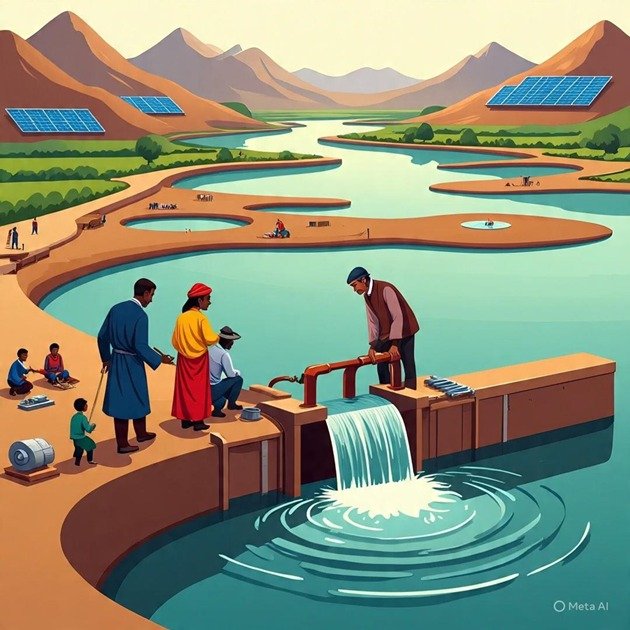
- Water Harvesting: Scaling up the construction of “Hafirs” (water reservoirs) and solar-powered boreholes to reduce dependence on erratic rainfall.
- Regional Cooperation: A legally binding agreement on the Grand Ethiopian Renaissance Dam (GERD) is essential to coordinate water releases and prevent catastrophic downstream flooding or drought in Sudan.
2. Climate-Smart Agriculture
- Heat-Resistant Crops: Distributing drought-tolerant seeds (such as specific sorghum varieties) that can survive 40°C+ temperatures.
- Sustainable Grazing: Establishing “peace corridors” for livestock that allow pastoralists to move safely to greener pastures without sparking conflict with local farmers.
3. Early Warning Systems (EWS)
Despite the conflict, international partners are working to rebuild the Sudan Meteorological Authority. Strengthening satellite-based early warning systems can give communities days of notice before a flood hits, saving lives and livestock.
Note: The “National Adaptation Plan” (NAP) highlights that Sudan requires over $13 billion in investment by 2050 to fully adapt to these changes.
Resources:
United Nations Report on Climate Change in Sudan (2026)
Sudan Climate Change Adaptation Project (2020–2027)
UNDP (United Nations Development Programme) Report on Climate Change in Sudan
Sudan First State of Environment and Outlook Report (2020)
WHO (World Health Organization) Report on the Impact of Climate Change on Health in Sudan (2019)