

What is Carbon Capture and Storage?
Carbon capture and storage (CCS) is a vital technology that plays a significant role in mitigating the impacts of climate change. As the world races to limit global warming and transition to a low‑carbon future, CCS has emerged as one of the most debated – and potentially transformative -technologies in the climate toolbox. While renewable energy, electrification, and efficiency improvements often dominate the conversation, CCS offers something unique: the ability to directly prevent carbon dioxide (CO₂) from entering the atmosphere, even from sectors that are notoriously difficult to decarbonize. Its role is not to replace other climate solutions but to complement them, filling critical gaps on the path to net‑zero emissions.
Image source: WTS Energy — “Carbon Capture and Storage (CCS)”
Why CCS Matters
The urgency of climate change is well established. To keep global temperature rise below 1.5°C, the Intergovernmental Panel on Climate Change (IPCC) stresses that global emissions must fall rapidly over the next few decades. Yet some industries – such as cement, steel, chemicals, and refining – produce CO₂ not only from burning fossil fuels but also from the chemical processes themselves. These “hard‑to‑abate” sectors cannot simply switch to renewable electricity and call it a day.
This is where CCS becomes essential. By capturing CO₂ at the point of emission and storing it permanently underground, CCS can significantly reduce emissions from industries that would otherwise struggle to decarbonize. In many climate models, including those used by the IPCC and the International Energy Agency (IEA), achieving net‑zero without CCS is technically possible but far more expensive and disruptive.
How CCS Works
CCS involves three main steps:
- Capture: CO₂ is separated from other gases produced during industrial processes or power generation. Technologies include post‑combustion capture, pre‑combustion capture, and oxy‑fuel combustion.
- Transport: Once captured, CO₂ is compressed and transported – usually via pipelines to a storage site.
- Storage: The CO₂ is injected deep underground into geological formations such as depleted oil and gas fields or saline aquifers, where it is trapped and prevented from re‑entering the atmosphere.
Some projects also use carbon capture and utilization (CCU), where CO₂ is turned into products like building materials, fuels, or chemicals. While CCU can reduce emissions, long‑term storage remains the most reliable way to ensure permanent removal.
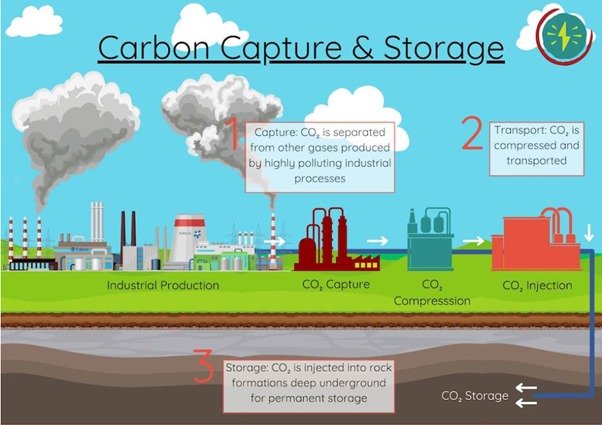
Image source: Oxpeckers.org — “Mpumalanga carbon capture”
CCS and the Path to Net Zero
One of the strongest arguments for CCS is its ability to address emissions that cannot be eliminated through renewable energy alone. For example:
- Cement production releases CO₂ from the chemical reaction that turns limestone into clinker. Even with clean energy, these process emissions remain.
- Steelmaking traditionally relies on coal as a reducing agent. While hydrogen‑based steel is promising, it is not yet widely available.
- Chemical manufacturing often produces CO₂ as an unavoidable by‑product.
CCS also plays a role in negative emissions when paired with bioenergy (BECCS) or direct air capture (DAC). BECCS captures CO₂ from burning biomass – plants that absorbed CO₂ while growing – resulting in net removal from the atmosphere. DAC, though currently expensive, directly extracts CO₂ from ambient air and stores it underground. Most net‑zero pathways rely on some level of negative emissions to balance residual emissions that cannot be fully eliminated.
Challenges and Criticisms
Despite its potential, CCS is not without controversy. Critics argue that it may prolong dependence on fossil fuels or divert investment away from renewable energy. Others point to the high costs, energy requirements, and the relatively slow pace of deployment to date.
These concerns are valid, but they do not negate the value of CCS. Instead, they highlight the need for careful policy design, transparent monitoring, and strong incentives to ensure CCS is used where it is most effective. Importantly, CCS should not be viewed as a license to continue business as usual; rather, it is a targeted tool for specific sectors where alternatives are limited.
The Road Ahead
Momentum for CCS is growing. Governments are offering tax credits and funding, companies are forming cross‑sector partnerships, and large‑scale storage hubs are being developed around the world. As costs fall and infrastructure expands, CCS is likely to become more accessible and more widely deployed.
Ultimately, mitigating climate change requires a portfolio of solutions. Renewable energy, electrification, efficiency, nature‑based solutions, and behavioral changes all play indispensable roles. CCS adds another layer of capability – one that addresses emissions that would otherwise be extremely difficult to eliminate. If deployed responsibly and strategically, it can help bridge the gap between today’s carbon‑intensive reality and a sustainable, net‑zero future.
Reference:
https://nap.nationalacademies.org/catalog/25259